Are your sustainability claims ready for EU scrutiny?

Header-image-full-width-1920-x-1080-169-scaled

    EU Green Consumer Directive

    The way organisations communicate sustainability claims in the European Union is changing rapidly. 

    The Empowering Consumers for the Green Transition Directive (ECGT) also known as EmpCo introduces stricter requirements to ensure that all claims made to consumers are clear, accurate and supported by evidence. For businesses operating in or selling into the EU, this marks a significant shift in how sustainability can be communicated.

    With the 27 September 2026 deadline approaching, businesses must prepare for stricter EU rules on sustainability claims. 

    Peterson Solutions helps companies identify, assess and improve sustainability claims before enforcement begins. 

    Request claims assessment
    About the directive

    What is EmpCo / ECGT?

    The Empowering Consumers for the Green Transition Directive (Directive (EU) 2024/825), commonly referred to as EmpCo or ECGT, strengthens EU consumer protection rules against greenwashing and misleading sustainability communication. The directive affects consumer-facing environmental claims made on packaging, websites, advertising, social media and other commercial communications.

    Under ECGT, sustainability claims are no longer only a marketing issue. They are also a compliance, governance and evidence issue. Generic or poorly substantiated claims may create legal, commercial and reputational risk.

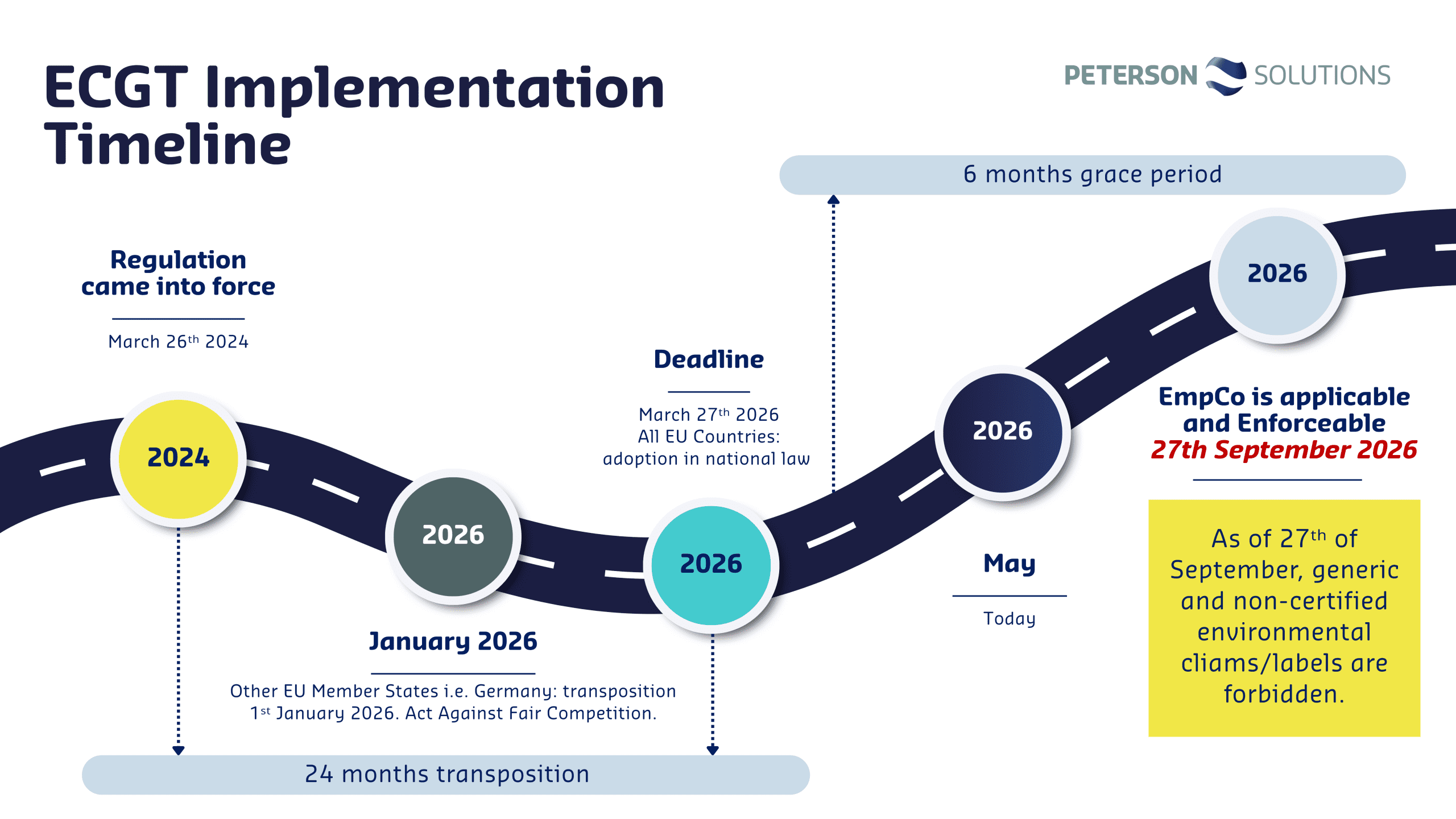
    Full application and enforcement starts on 27 September 2026. EU Member States were required to transpose the directive into national law by 27 March 2026.

    No. CSRD reporting can provide useful data, but ECGT focuses on consumer-facing claims and how the average consumer understands them. A claim can be based on real data and still be misleading if it is too broad, vague or poorly framed.

    Do you use any of these claims?

    • Green

    • Eco-friendly

    • Sustainable

    • Carbon neutral

    • Climate neutral

    • Low impact

    • Recyclable / recycled

    • Own sustainability label

    Our approach

    From risk identification to implementation

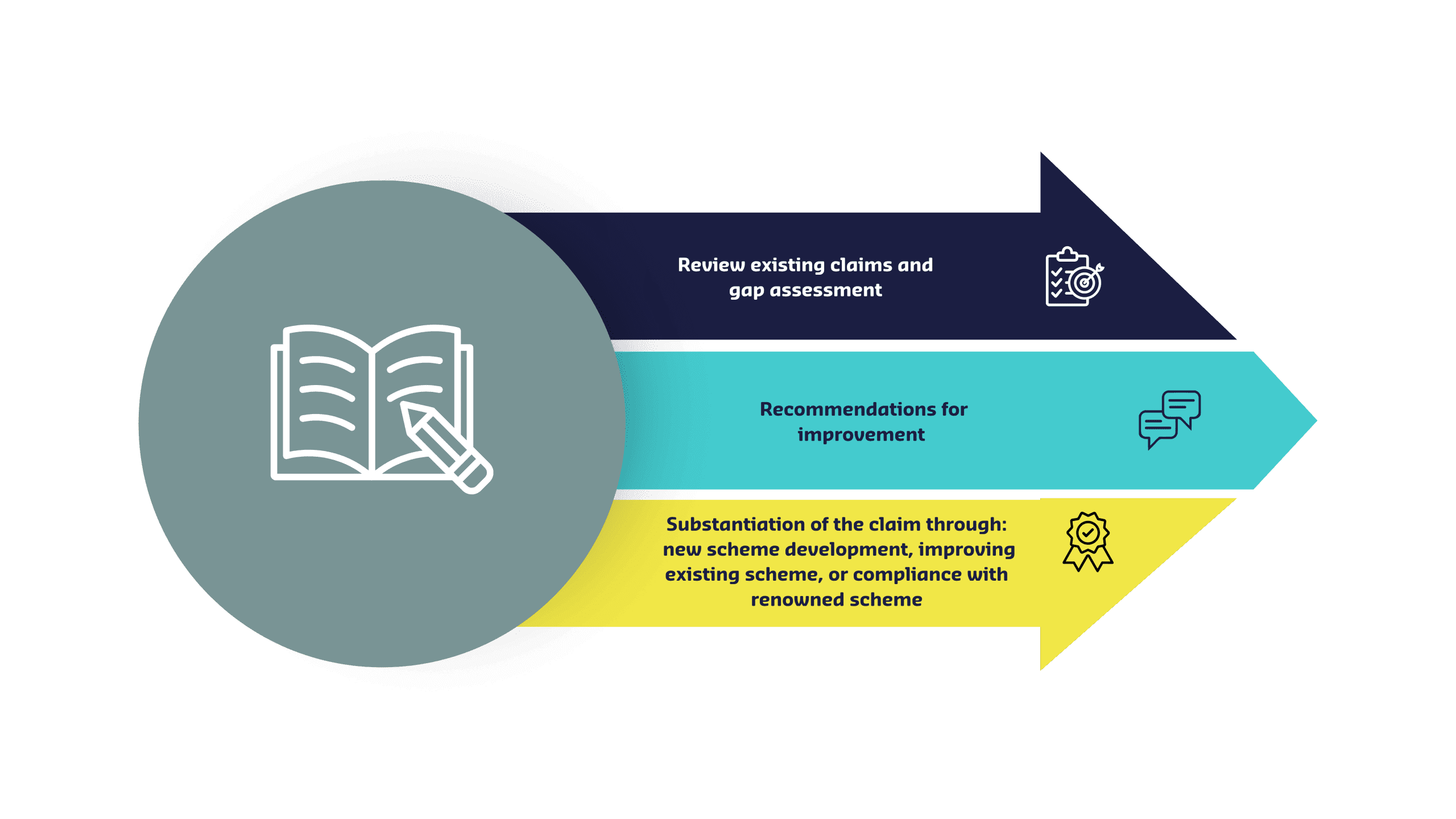
    1. Risk Assessment
    Identify sustainability claims, labels and potential exposure across websites, packaging, reports and marketing communication.
    Typical engagement: 2–4 weeks

    2. Action Plan
    Receive a practical remediation roadmap including claim prioritisation, governance improvements and communication recommendations.
    Typical engagement: tailored project scope

    3. Implementation
    Support with evidence building, certification, traceability, claim substantiation and implementation across teams and supply chains.
    Typical engagement: implementation support tailored to business needs

    Discuss your claims exposure
    Header-image-full-width-1920-x-1080-169-scaled
    Peterson Solutions combines sustainability expertise, certification support, supply chain knowledge, traceability and implementation capability to help companies connect sustainability claims with credible evidence and operational reality. Our specialists support companies across agriculture, textiles, food, forestry, manufacturing and global supply chains.

    27 September 2026 is approaching

    Review your sustainability claims now and reduce greenwashing risk before enforcement begins

    Check your green claims risk

    Peterson-Solutions-certifications-homepage

    FAQ section

    The EU Green Consumer Directive is commonly used to refer to Directive (EU) 2024/825, the Empowering Consumers for the Green Transition Directive. It updates EU consumer protection rules to address greenwashing, unreliable sustainability labels, vague environmental claims and misleading product information.

    Full application and enforcement start on 27 September 2026. EU Member States were required to transpose the directive into national law by 27 March 2026.

    It applies to businesses making consumer-facing sustainability or environmental claims in the EU, including non-EU companies selling products or services to EU consumers.

    Generic environmental claims such as “green”, “eco-friendly”, “sustainable” or similar wording can be prohibited if they are not clearly substantiated and explained in a way that consumers can understand.

    Yes, but sustainability labels must be based on recognised third-party certification schemes or public authority endorsement, with transparent criteria and independent monitoring.

    No. CSRD reporting can provide useful data, but ECGT focuses on consumer-facing claims and how the average consumer understands them. A claim can be based on real data and still be misleading if it is too broad, vague or poorly framed.

    Start by creating an inventory of all environmental and sustainability claims, then assess each claim against ECGT criteria and identify which claims need evidence, rewriting, certification support or removal.

    Peterson Solutions supports companies with claims inventories, gap assessments, evidence and substantiation, supply chain traceability, certification support, compliant communication and training for internal teams.

    How can we help?

    Portrait of young arab businessman, man smiling and looking at camera while sitting inside office, boss in business suit at workplace using laptop
    Name(Required)